The Balloon Analogue Risk Task, commonly known as the BART, is a computerized behavioral measure of risk-taking developed by Carl W. Lejuez, Jennifer P. Read, Christopher W. Kahler, Jerry B. Richards, Susan E. Ramsey, Gregory L. Stuart, David R. Strong, and Richard A. Brown. First published in 2002 in the Journal of Experimental Psychology: Applied (Volume 8, Issue 2, pages 75–84), the BART has become one of the most widely cited risk-taking paradigms in behavioral psychology.
How the BART Works
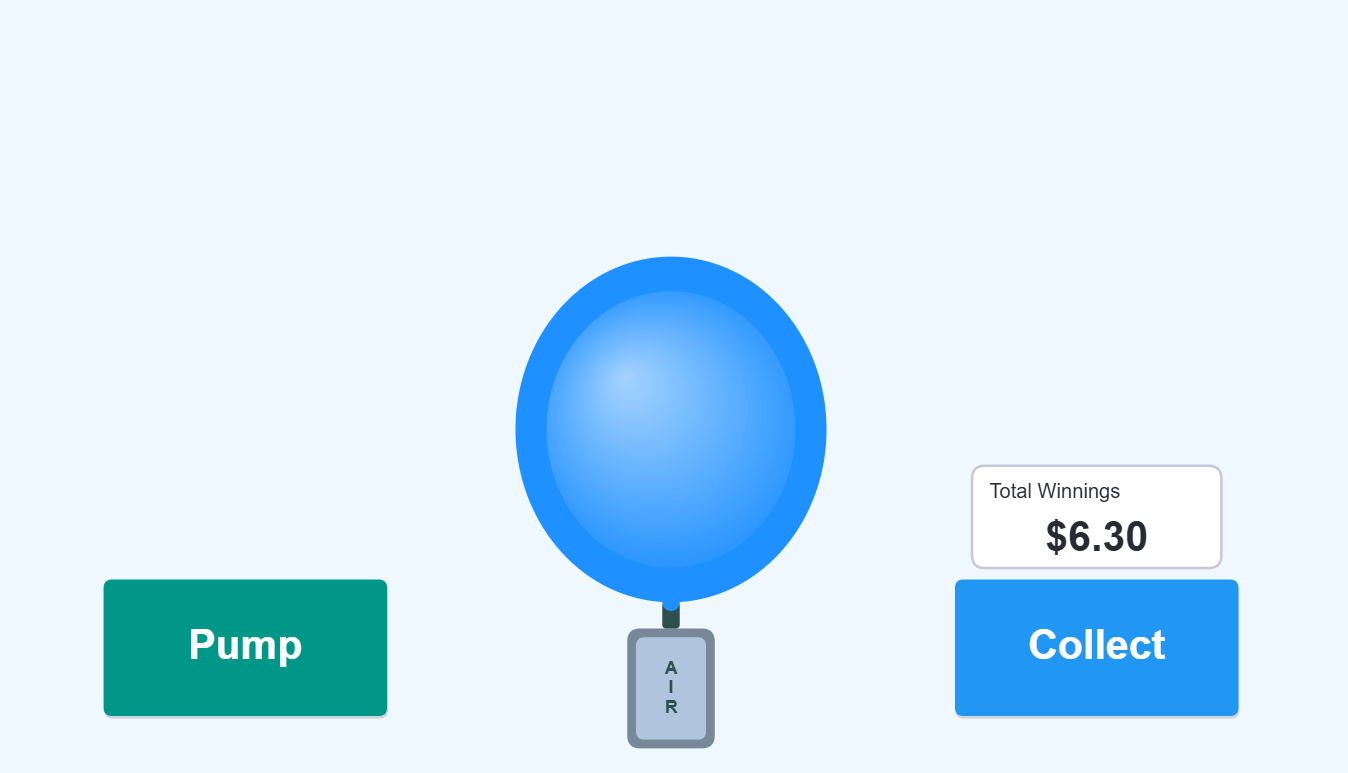
During the Balloon Analogue Risk Task, participants are presented with a virtual balloon on a computer screen. Each button press inflates the balloon and earns a small monetary reward that accumulates in a temporary bank. However, each pump also increases the probability that the balloon will explode. If the balloon explodes, all earnings for that trial are lost. Participants must decide when to stop pumping and collect their earnings, creating a direct tradeoff between risk and reward that mirrors real-world decision making.
BART Scoring and the Adjusted BART Score
The primary outcome measure of the BART is the adjusted average number of pumps, calculated as the mean number of pumps on trials where the balloon did not explode. This adjusted BART score (Adj BART) provides a reliable index of risk-taking propensity. Higher adjusted scores indicate greater risk-taking behavior. The BART has demonstrated acceptable test-retest reliability and correlates significantly with self-reported real-world risk behaviors including substance use, unsafe sexual behavior, gambling, and sensation seeking.
Lejuez et al. (2002) – The Original BART Study
The original evaluation of the BART by Lejuez and colleagues in 2002 established the task as a valid behavioral measure of risk taking. Riskiness on the BART was significantly correlated with scores on measures of sensation seeking, impulsivity, and deficiencies in behavioral constraint. The BART accounted for variance in addictive, health, and safety risk behaviors beyond that explained by demographics and self-report measures alone. Citation: Lejuez, C. W., Read, J. P., Kahler, C. W., Richards, J. B., Ramsey, S. E., Stuart, G. L., Strong, D. R., & Brown, R. A. (2002). Evaluation of a behavioral measure of risk taking: the Balloon Analogue Risk Task (BART). Journal of Experimental Psychology: Applied, 8(2), 75–84.
Why Use This Version of the BART
This platform provides the standardized, authorized version of the Balloon Analogue Risk Task endorsed by the original developer, Carl W. Lejuez. Unlike third-party implementations, this version ensures fidelity to the validated task parameters described in the original publication. The platform is free, web-based, and designed for use in academic and clinical behavioral research. Researchers can administer the BART to participants remotely using unique experiment codes, and data is collected in a standardized format suitable for peer-reviewed research.
Applications of the BART in Research
The Balloon Analogue Risk Task has been used extensively in psychology, neuroscience, addiction research, clinical assessment, and public health studies. Research areas include risk-taking in adolescents, substance abuse and addiction, gambling behavior, driving behavior, brain imaging studies using fMRI and EEG, clinical populations with traumatic brain injury, and individual differences in impulsivity and sensation seeking. The BART is also referred to as the Balloon Analog Risk Task (American English spelling) and is indexed under both spellings in academic databases.
What is the BART?
The Balloon Analogue Risk Task (BART) is a computerized laboratory measure of risk-taking behavior that has been used in many different behavioral research contexts. This platform provides researchers with an open access, easy-to-use, standardized version of the task for behavioral studies.
Originally developed by Carl W. Lejuez and colleagues at the University of Maryland, the BART has been utilized in numerous studies and has demonstrated correlations with real-world risk behaviors.
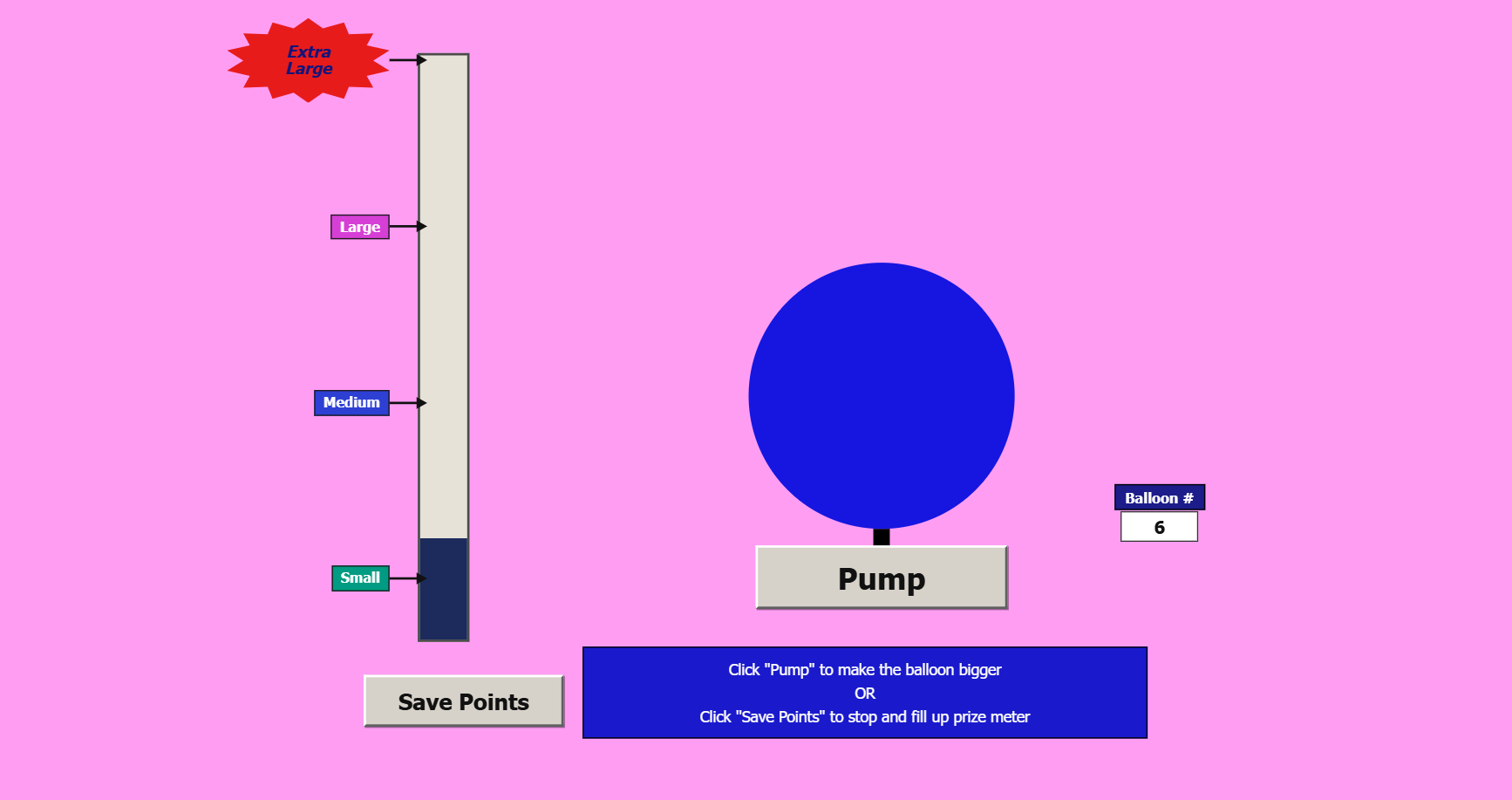
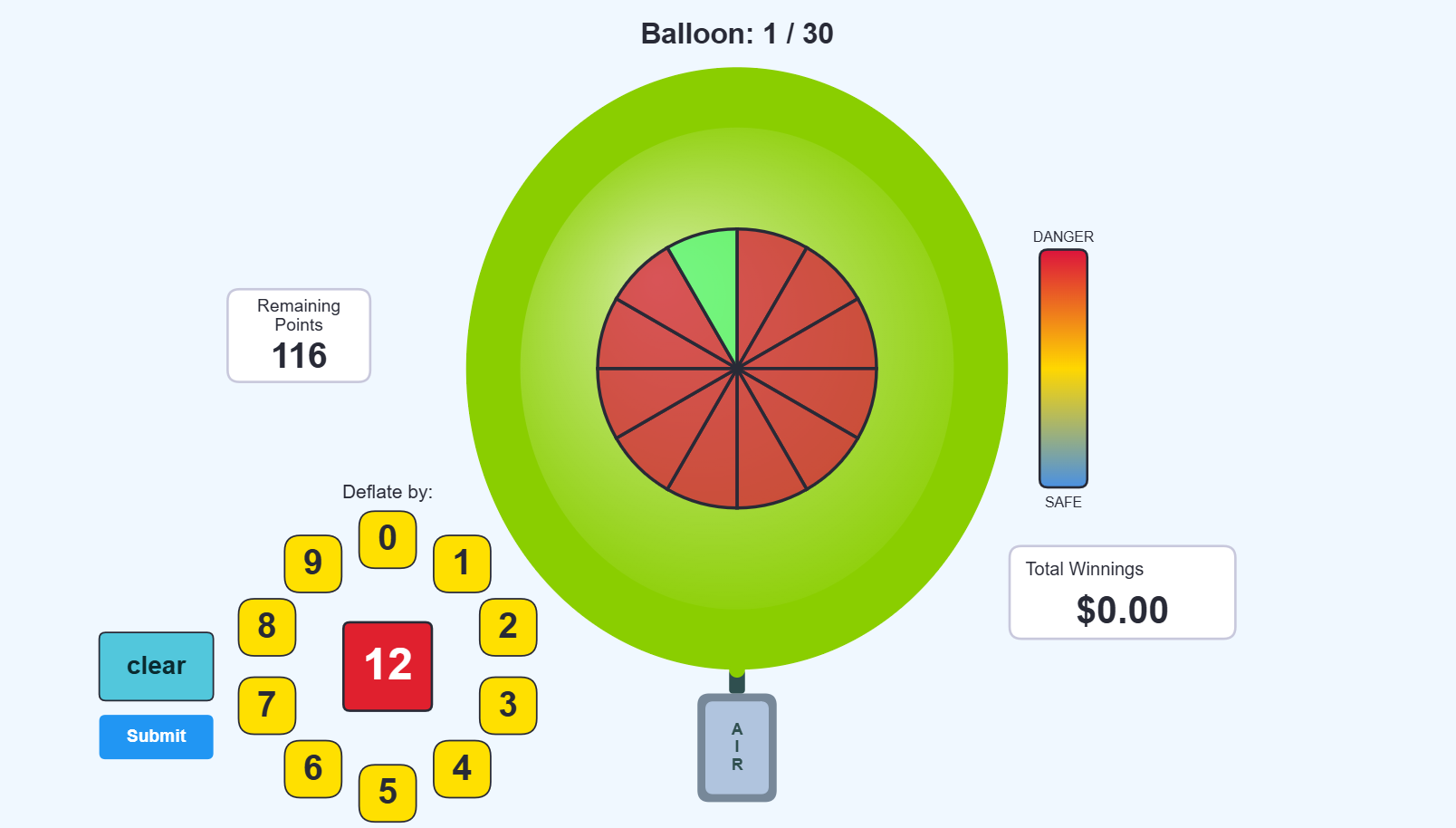
This platform hosts three BART-based tasks. All three share the same researcher portal. Researchers can administer any combination of the tasks within a single study.
Original BART
Citation
Lejuez, C. W., Read, J. P., Kahler, C. W., Richards, J. B., Ramsey, S. E., Stuart, G. L., Strong, D. R., & Brown, R. A. (2002). Evaluation of a behavioral measure of risk taking: The Balloon Analogue Risk Task (BART). Journal of Experimental Psychology: Applied, 8(2), 75–84. https://doi.org/10.1037/1076-898X.8.2.75
BART-y
Citation
Lejuez, C. W., Aklin, W. M., Daughters, S. B., Zvolensky, M. J., Kahler, C. W., & Gwadz, M. (2007). Reliability and validity of the youth version of the Balloon Analogue Risk Task (BART–Y) in the assessment of risk-taking behavior among inner-city adolescents. Journal of Clinical Child & Adolescent Psychology, 36(1), 106–111. https://doi.org/10.1080/15374410709336573
Balloon Risk Avoidance Task
Citation
Crowley, M. J., van Noordt, S. J. R., Castagna, P. J., Vaca, F. E., Wu, J., Lejuez, C. W., & Mayes, L. C. (2022). Avoidance in adolescence: The Balloon Risk Avoidance Task (BRAT). Journal of Psychopathology and Behavioral Assessment, 44(2), 297–311. https://doi.org/10.1007/s10862-021-09928-6
×
Experiment Access
Enter the unique code provided by your research coordinator